Train your engineers to build software with AI — across the whole lifecycle, not just the editor.
A five-week hands-on program that teaches your engineering teams one consistent way of planning, building, testing, deploying and maintaining software with AI assistants — on the tools you already use.
- 5 weeks
- About 100 contact hours
- Your AI tool, your stack
- No access to your code needed
Your engineers already use AI. It shows up in the code, not in delivery.
AI makes individual developers faster. Delivery still depends on planning, review, testing and release — and that is where adoption usually stalls. This program is built for engineering sub-teams that look like one of these:
Traditional process
A working SDLC, little or no AI in it. The team needs foundations: directing AI work, writing usable specs, reviewing AI output.
Uneven adoption
Some engineers use AI heavily, others not at all. Output quality varies, and nobody shares context or review habits.
Disconnected AI workflows
AI is used in the editor, but specs, tests, pipelines and incidents are still handled the old way. Nothing carries through.
One connected way of working, from request to release.
The lifecycle is taught as a repeatable loop. Each step leaves a specification, a change or a review record for the next. AI assistants plan, build and verify; people review the key decisions and approve changes.
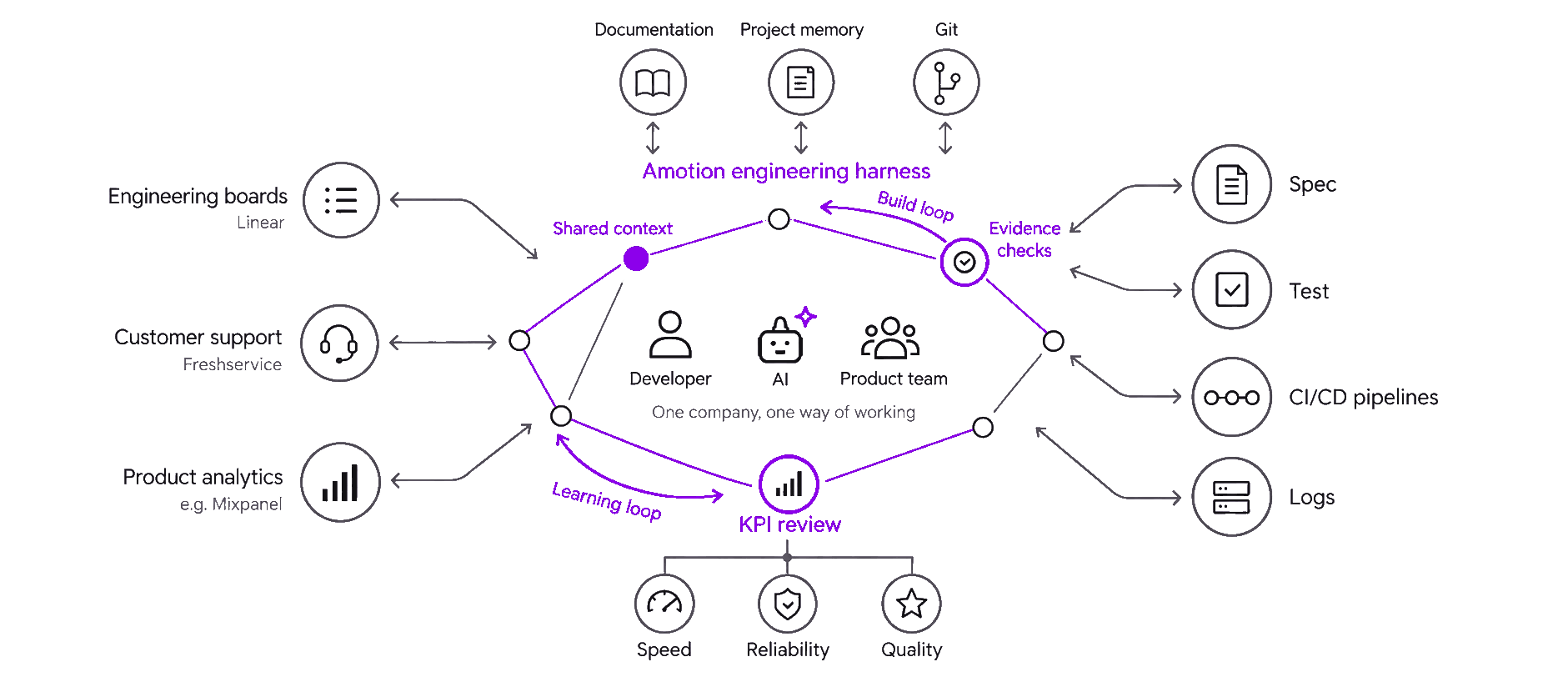
Turn a request into a proportionate spec with acceptance criteria, linked to a work item.
Direct multi-file changes through a clear plan and repository context. Debug, inspect, review.
Derive tests from acceptance criteria, cover failure paths, verify AI-generated work independently.
Read pipeline results, apply security checks, practise release, rollback and recovery.
Investigate an operational finding, separate evidence from assumptions, turn it into follow-up work.
Used throughout: repository instructions, project memory and reusable skills, a source-linked knowledge base (LLM Wiki) and tool connections through MCP — at the depth that suits each sub-team.
Week one finds your starting point. Weeks two to five are practice.
Every session follows the same cycle: short explanation, guided lab, homework, feedback next session. Sessions run two to four hours, daily or on alternate days, planned around your release commitments and holidays. All sessions are recorded.
Stack, process, tools, current AI use. Each sub-team gets a profile and a training emphasis.
Set up the chosen tool and training repo. Turn a request into acceptance criteria and a plan.
Implement a feature or fix across files, debug, run checks, explain the change to a reviewer.
Tests from acceptance criteria, failure cases, defect reproduction, the implement-test-correct cycle.
CI/CD results, security checks, release and rollback scenarios, closing learning review.
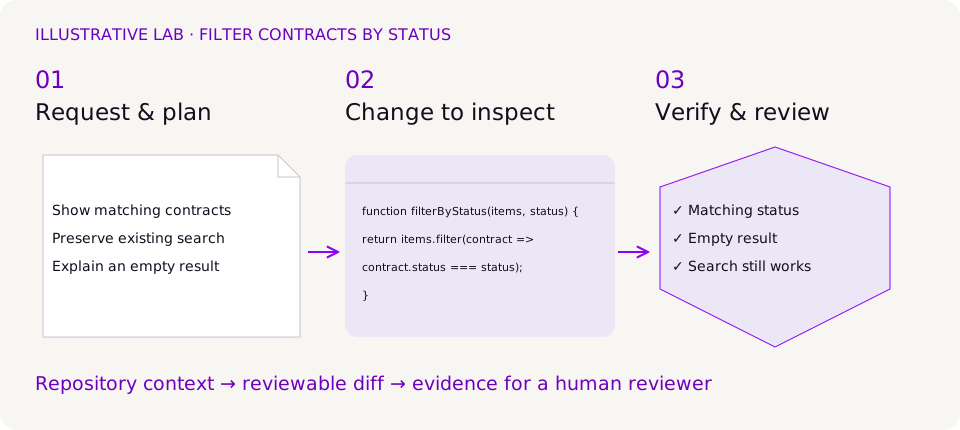
Scroll across to explore the diagram →
Taught on your tools, on prepared code, with nothing of yours at risk.
The method is tool-neutral. Your team picks the assistant; we teach every practice on that tool.
- Claude Code
- GitHub Copilot
- Cursor
- OpenAI Codex
- Linear
Your AI tool
Claude Code, GitHub Copilot, Cursor, OpenAI Codex or another approved assistant.
Your stack
Your IDE, languages, CI/CD and security tooling. We recommend Linear for tracking; any tracker works.
Prepared repositories
Exercises run on our example projects with synthetic data. No access to your code or production systems is needed.
Labs, homework, feedback
Participants practise, submit follow-up tasks and get reviewed. Every session is recorded for anyone who misses one.
What you walk away with
- A profile of each sub-team: starting point, training emphasis, tool and workflow recommendations.
- About 100 hours of live training, labs and coaching, led by a Technical Program Lead with a Program Coordinator.
- Reusable templates: specifications, repository instructions, review and security checklists.
- Session recordings and all lab material for onboarding the next cohort yourself.
- A closing learning review: what each participant demonstrated independently and where more practice is recommended.
What you bring
- A cohort of developers and engineering leads; QA, DevOps and product join the relevant sessions.
- One coordinator as the single point of contact and one decision maker (can be the same person).
- Laptops with Git and an IDE, a licence for the chosen AI tool, and time blocked with participants' managers.
- Ownership of adoption. We teach the practice; your organisation decides and implements changes to its own repositories and workflows.
Scroll across to explore the diagram →
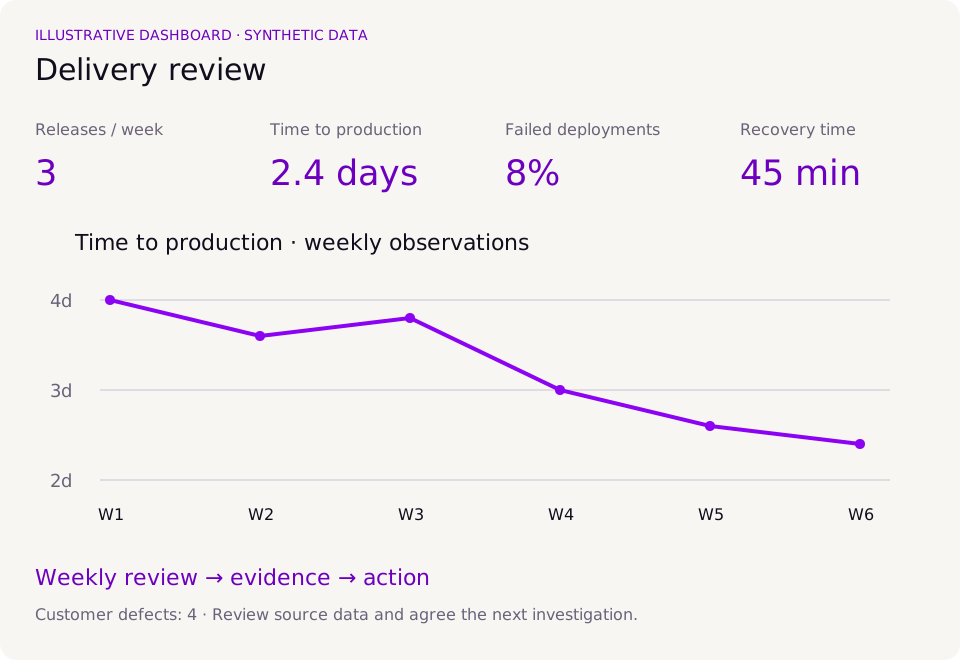
Measure the difference yourself with DORA metrics.
Your team learns to select engineering KPIs, map data sources, build a dashboard and run weekly performance reviews — starting from release frequency, time to production, deployment failures, recovery time and customer defects.
Runs alongside or after the main program. Your team builds and runs the dashboard; we teach and coach.
Ready to make AI show up in how your team delivers?
Tell us about your sub-teams and the tool you use. We will come back with a cohort plan, dates and commercials.
founders@amotion.aiAmotion · Registered member of the Claude Partner Network · Methodology informed by the Claude Academy AI-Native SDLC Playbook